I've been watching a BBC series via You Tube recently called '
Who do you think you are?' It had already started before we left the UK and I'd quite enjoyed seeing a 'celebrity' tracing their ancestry back - either a few generations or sometimes several. I was always quite surprised by how moved the people were to discover what had happened to their distant and quite unknown relatives. Many a tear falls in many shows and for many different reasons - and there have been a lot of episodes as it's been running for around 6 or even 7 series. I've lost count of the number of people who have all expressed a similar sense of having made a connection, of feeling more grounded, of being much more aware of a sense of family.
I know that
Janice has done a lot of research into her family history and has uncovered a lot of amazing information, particularly about her bigamist (twice over, as I remember) grandfather. My sister has done some digging into our own family and a couple of years ago, we went through some old photographs that I hadn't seen before and tried to piece together a few odd bits of information that we had.
Our mother is an only child and her mother, my Granny, is also an only child. Sticking with this side of the family to start with, I have taken things a little further than Judy did. And discovered something quite interesting...
We had always been told that the family of my great-grandfather, William Gillbanks, who died in 1917 in the First World War (and who is buried in northern France) came from Kendal in Westmoreland. Kendal was the little town we would come to on our way to the Lake District when we were children. Now the motorway bypasses the town but I remember it with interest and have wondered why anyone would leave there to come to Bradford. In the first half of the 19th Century, a young William Gillbanks set up on his own in the family business of Rope and Twine making. He worked out of a shop on All Hallow's Lane, a street that is still central to Kendal. He married a girl whose surname was Bolton but whose first name I don't know. They had four daughters together, though one, Isabella, died after a long and painful illness at the age of six - and her mother not long after. In 1854, William then married his wife's sister - Mary Bolton. His two eldest daughters moved away from home and worked as milliners but Elizabeth, the youngest stayed on at home and showed up on the 1861 census. By this time, my great-great grandfather had been born - John Wilson - and when he was just eight years old, a dreadful thing took place in All Hallow's Lane.
I found reference to it on the
FindmyPast website and although there's a free 14 day trial, I had to pay to access the newpaper cutting that held the vital information. It was worth it though!
 |
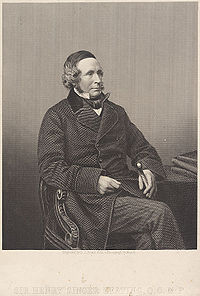
Sir Henry was not impressed with
my great-great grandfather
for a number of reasons... |
In all the local papers at this time, there was reference to the death of Mary, John Wilson's mother and William Gillbanks' second wife. (A wife, which although a marriage had taken place, was not reckoned to be a 'legal' one by Sir Henry Singer Keating, who merits a mention and a photo on Wikipedia no less and who presided over proceedings this day. Apparently one should not marry one's wife's sister....I suppose there's little difference between one's sister's husband and one's brother's wife when you stop to think about it.)
On the Saturday 20th February, 1863, Elizabeth, then 18 and step-daughter to Mary, stood accused of her manslaughter no less!
There's a very full account of the trial and what happened on the day in the Gillbanks household. Mary, according to her husband, had started drinking a couple of years after their marriage and for about 8 weeks prior to her death had rarely been sober. Obviously we don't hear Mary's side to this! Apparently, she often became violent, was known to the police and had attacked William a couple of times - permanently blinding him in one eye on one occasion! On the day in question, William and his son, John (who at 8 was also called to stand witness in the trial) had been out to buy some buns, (curiously called 'wigs' in Kendal at this time) and when they returned, both Mary and Elizabeth went to pick up the basket at the same time. A struggle ensued during which Mary threatened to hit Elizabeth with a watering can which she had in her hand. William took the can from his wife but then Mary picked up a heavy lead pipe and to Elizabeth, she threatened to 'split her skull' with it. She didn't but turned away and as she did so, Elizabeth picked up and threw a piece of earthenware pot at her - which cut her above and just behind her left ear - a cut not quite an inch in length. Still carrying the pipe, Mary went out of the house and to a neighbours where the wound was bathed. This all happened at about 12 o'clock. At 1.30, Mary returned to the neighbours, still bleeding, where further attempts were made to stop it. William came in and one of the neighbours told him he should fetch a doctor, which William refused to do. He also told the neighbour to mind her own business. Mary didn't ask for a doctor and appeared to make light of the wound. She returned home and went up to her bed.
By 6 o'clock, she had bled to death.
William's halting and unwilling attitude as a witness almost tipped things against Elizabeth and twice, the judge had to speak severely to him. He did not escape considerable criticism for not sending for a doctor and allowing his wife to reach her death without proper medical care. But in the end, Elizabeth was acquitted of the charge of manslaughter. She, her father and her two older sisters all continued to live together in the same house until William's death in 1872. After that I could find no further trace of the Gillbanks sisters, they disappear from all records. I know they never married because my Great Grandma always said that Granny inherited her 'prudish' nature from her husband's Great Aunts, who remained spinsters ....I guess my Great Grandma didn't know what they had been through.
And the effect of this knowledge on me? Well, it has been incredibly interesting and I have looked at All Hallow's Lane in Kendal on Google Maps where it appears perfectly respectable when the photos were taken. I have been very conscious of imagining the setting and the scene on the day of the crime and find myself very sympathetic towards Elizabeth - described as 'the prisoner' in the newspaper. I wonder if she had spent Christmas and New Year in prison as the incident happened on 22nd December, whilst the trial didn't happen for another two months. And I think I understand a little better now why John Wilson might have been moved to leave Kendal and make his way to Thornton in Bradford at the earliest possible opportunity.
All of that is another story though.
Having two hundred years of my family history set out in front of me hasn't made a huge difference to the way I think now but it is rather satisfying to know that I know it, if that makes sense. I suspect that if I were still living in England, I would be making a few visits to places I wouldn't otherwise visit, Kendal included, looking for a few more clues. What skeletons do you have in your cupboard, I wonder?